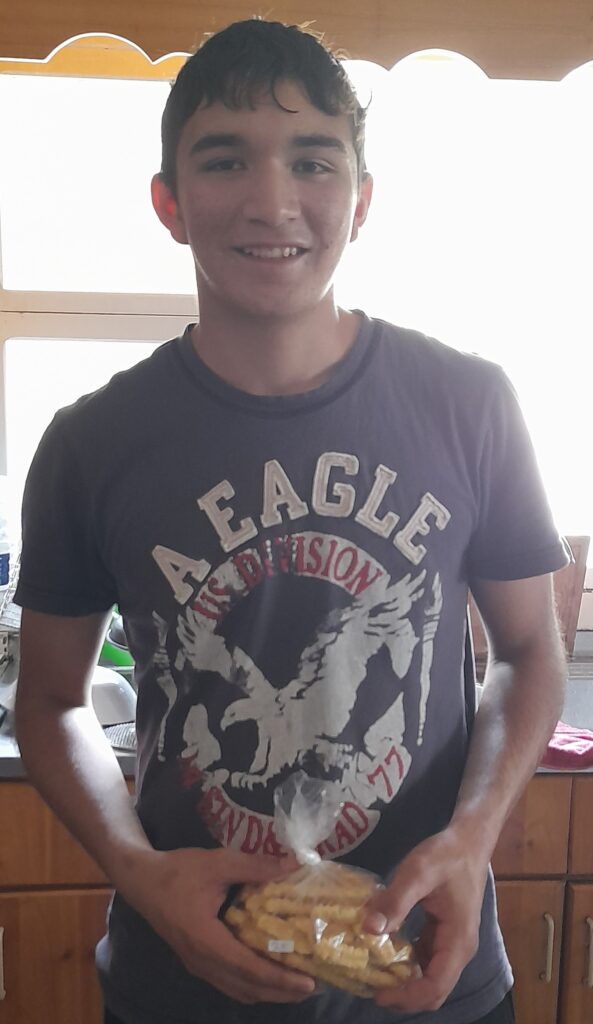
Alan is a 15-year-old Paraguayan boy whose early life was marked by severe neglect. Raised by a single mother alongside his older sister (then about four years old), he was locked away from a very young age. Rescued at around 18 months old, he and his sister had been left for days or even a week or two at a time in a room with dogs and cats, a bucket of water, and a bag of bread while their mother traveled to Asunción.
An aunt discovered the children in this condition and reported it to the police. The sister was placed with their grandmother; Alan was adopted by a German Seventh-day Adventist couple.
At the time of the adoption the couple had been unable to have children of their own. They provided Alan with a loving home and patiently taught him basic human skills he had never learned — including how to eat properly, as he had previously mimicked the animals he lived with. He arrived severely emaciated.
Over the years the couple did go on to have three biological children of their own. Tragically, one of those children died in his sleep. Because of their religious beliefs the parents did not seek medical treatment for the child before his death; they arranged the burial themselves. The adoptive mother was subsequently arrested and is currently waiting to be charged or released, depending on the outcome of her legal representation.
Despite the gaps in formal education (which the adoptive parents did not prioritise), Alan is unable to read or write but is now fluent in Spanish, High German, Low German, his native language, and learning English.
He has reconnected with his biological father, a mathematician living in Filadelfia, and has begun an online English program. His biological mother has since had two more children and remains under government supervision.
The story remains one of remarkable resilience: a child who began life in extreme deprivation has grown into a multilingual teenager actively pursuing further learning and family reconnection, even amid the later tragedies that struck his adoptive family.
I first met Alan at Iparoma, and from the start it was clear what a genuinely good person he is. He’s always ready to lend a hand, whether it’s helping with the daily chores or stepping in whenever something needs doing. What stands out most is how willingly and cheerfully he pitches in — he doesn’t wait to be asked, he just sees what needs attention and gets to work. He is truly inspirational.